 Skip to content
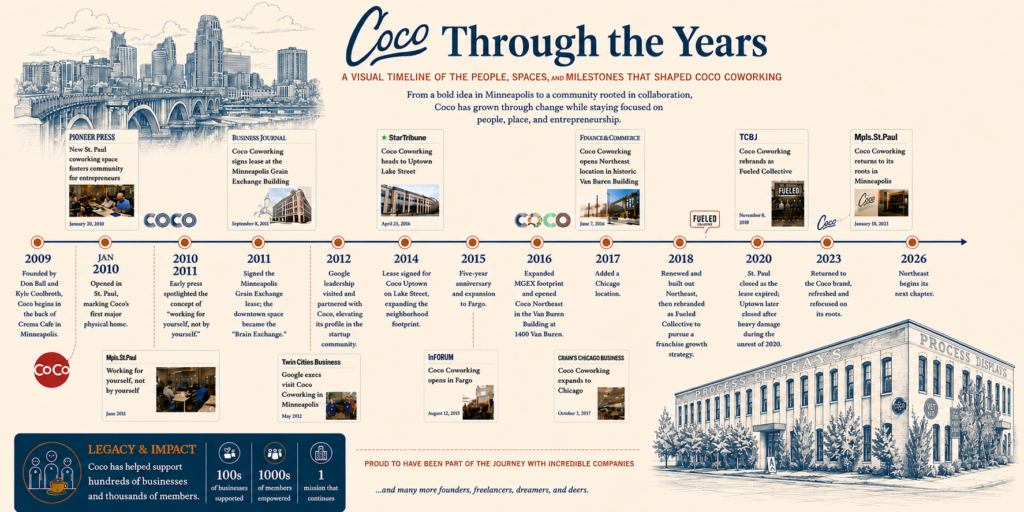
As we get ready to reopen Coco Northeast, we have been digging into the history of Coco Coworking through old newspaper clippings, photographs, letters and stories from across the years. Together, they tell the story of a local idea that helped introduce coworking to Minnesota and kept changing as the way people work changed around it.
What began with independent workers meeting at a Minneapolis coffee shop grew into a community with homes in Lowertown, the historic Minneapolis Grain Exchange, Uptown, Northeast, Fargo and Chicago. Coco expanded, changed names, weathered major disruption and eventually returned to its Minnesota roots. Through all of it, one idea has remained: people do better work when they have a place to focus and other people nearby.
2009 and 2010: From Crema Cafe to Lowertown
Coco was established in 2009 by cofounders Don Ball and Kyle Coolbroth. Before there was a permanent space, there was an early coworking experiment at Crema Cafe in Minneapolis. Independent workers gathered there so they could work near one another instead of spending every day alone at home.
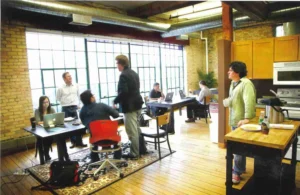
In January 2010, Coco opened its first permanent location in a renovated warehouse in Lowertown, St. Paul. Coworking was still unfamiliar to most people in Minnesota. Early local reporting described Coco as one of the places introducing the concept to the Twin Cities.
The opening day was memorable for reasons no one planned. It was also the first day of light rail construction outside the building. Don later remembered:
“The entire building was shaking from the pile drivers.”
The setting was hardly ideal, but the idea found an audience. Independent professionals wanted something more reliable than a coffee shop and more flexible than a traditional office. They also wanted other people around them.
Coco gave freelancers, consultants, founders, technologists and small teams a professional place to work without having to work in isolation.
2011: The Grain Exchange becomes the Brain Exchange
In 2011, Coco expanded into the former trading floor of the historic Minneapolis Grain Exchange. The exchange had moved to electronic trading, leaving the dramatic downtown floor quiet for several years.
Then Minneapolis Mayor R.T. Rybak encouraged Coco’s founders to consider the space. He also gave it an unofficial nickname that became part of Coco lore: the “Brain Exchange.”
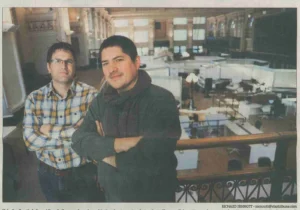
The move gave the young coworking company a highly visible home in downtown Minneapolis. Startup founders, freelancers, creative professionals, consultants, nonprofits and small companies could work alongside one another in a setting unlike a conventional office.
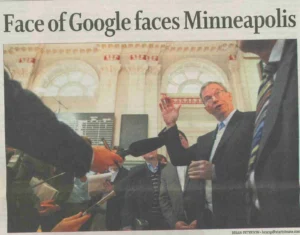
In November 2011, Google Executive Chairman Eric Schmidt visited Coco and met with local entrepreneurs. The visit drew media attention and helped begin a longer relationship between Coco and Google.
2013: Google, Uptown and a growing startup community
By 2013, Coco’s relationship with Google had grown beyond a single visit. Coco partnered with Google on programs for entrepreneurs and became one of the original hubs in Google’s North American Tech Hub Network.
That same year, Coco opened an Uptown Minneapolis location on Lake Street. With spaces in St. Paul, downtown Minneapolis and Uptown, Coco was becoming part of the region’s startup and small business infrastructure.
Members were building companies, serving clients, hiring employees, testing ideas and meeting collaborators. Some businesses stayed and grew inside Coco. Others eventually moved into offices of their own.
Much of the value came through ordinary moments: an introduction, advice from someone nearby or a conversation that became a new project.
2014 and 2015: Growth, Fargo and a new home in Northeast
Coco also tested a new market in Fargo. The location opened in 2014 and closed in June 2015 after membership did not grow enough to sustain it.
That short chapter belongs in the story because Coco’s growth was never automatic. The company learned by trying, listening and adjusting.
When Coco marked its fifth anniversary in January 2015, it reported:
- 800 members across four locations
- 176 events hosted during 2014
- More than 10,000 visitors
- 456 tours
- 52,695 cups of coffee served
In July 2015, Coco opened its fourth Twin Cities location at 1400 Van Buren Street NE. The 13,000 square foot space occupied the former Sport Ngin headquarters in the historic Van Buren building.
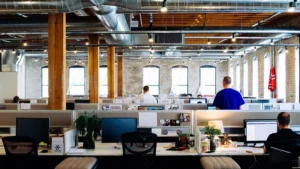
It included dedicated desks, meeting rooms, team campsites, private startup suites, phone booths, common work areas and a rooftop patio.
Northeast had been one of the locations most requested by members. The neighborhood’s mix of artists, makers, small businesses, restaurants and breweries made it a natural fit. The brick, timber, daylight and warehouse character of the building gave Coco Northeast an identity of its own.
2016: More room downtown and a step into Chicago
In May 2016, Coco acquired Enerspace Chicago in the West Loop, making it the company’s fifth location. The move gave Coco a presence in another major Midwestern startup community and reflected the company’s growing ambitions.
Later that year, Coco announced a 15,000 square foot expansion at the Minneapolis Grain Exchange. The project added capacity for approximately 250 more workers, renovated the existing space and created a larger venue for events and company gatherings.
2018: Coco becomes Fueled Collective
In 2018, Coco rebranded as Fueled Collective as part of a national franchise strategy. The concept combined workspace with hospitality, events and social connection.
Kyle later wrote candidly about why the name changed and why longtime members kept calling it Coco anyway.
The change showed how far the company had come from its original Lowertown workspace and how much confidence its founders had in the community and operating model they had built.
The Twin Cities locations continued operating, but the Coco name still meant something specific here. It was connected to the Grain Exchange, Lowertown, Uptown, Northeast, startup events, first offices, workshops and years of relationships.
2020: Contraction, disruption and resilience
The pandemic changed the coworking industry almost overnight. Shared spaces and spontaneous interaction, two of coworking’s greatest strengths, suddenly became much more complicated.
Coco’s original St. Paul lease expired in 2020 and was not renewed. The Uptown location also closed after sustaining extensive damage during the civil unrest on Lake Street following George Floyd’s murder.
Colleen Moselle had been serving as Coco’s president and chief operating officer since 2019. She helped guide the company through the pandemic, the location closures and the major shift toward remote and hybrid work.
Coco went from four Twin Cities locations to its two Minneapolis locations at the Grain Exchange and in Northeast.
2023: The Coco name returns
In April 2023, the company stepped away from the national franchise strategy and returned to the Coco name. The decision refocused the business on its Minnesota community and reclaimed the identity that members had continued to associate with the company.
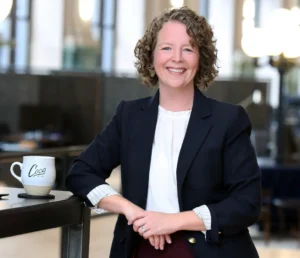
On September 1, 2023, Colleen became CEO after four years as president and chief operating officer. The transition recognized the role she had already played in guiding Coco through one of the most difficult periods in its history.
By that time, Coco reported that it had served more than 6,000 entrepreneurs, startups, small and midsize businesses, nonprofits and large companies since its founding.
2026: New ownership and the next chapter of Coco Northeast
In 2026, Colleen purchased Coco from the company’s ownership group. The transition keeps Coco locally owned and led by the person who has guided the business since before the pandemic.
Today, Coco operates two Minneapolis locations: the historic Grain Exchange downtown and the Van Buren building in Northeast.
Coco Northeast is being renovated for the way members and teams work today. The renewed space is planned around private offices for small teams, quiet areas for focused work, meeting rooms for clients and groups, and shared spaces for collaboration and community.
Coco Northeast is scheduled to reopen during the first week of August 2026.
The renovation continues a pattern that has shaped Coco since 2009. Pay attention to how work is changing. Listen to what members need. Create a place that helps people do their best work without having to do it alone.
A history shaped by the people who worked here
Coco’s history can be mapped through dates, buildings and logos. What gives those milestones meaning are the people who worked here.
Across the years, members have come to Coco to build companies, serve clients, host events, find collaborators and create professional homes. Some came for a single day. Others became part of the community for years.
To everyone who has been part of Coco’s story, thank you. We look forward to welcoming members back to Northeast and seeing what gets built next.
Explore Coco Northeast and book a call or tour.
This story was compiled from Coco’s archive of newspaper coverage, company records, photographs and letters.